A witty and playful poem about Macavity, the Napoleon of Crime — a
ginger cat who is a master criminal, a fiend in feline shape, and
always, always absent from the scene of the crime.
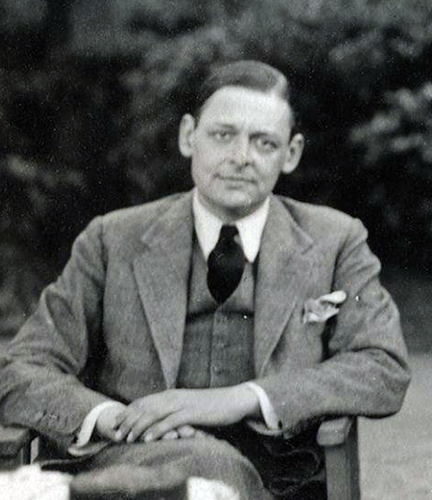
One of the most influential poets of the twentieth century — and a
lover of cats.
Thomas Stearns Eliot (1888–1965) was born in St.
Louis, Missouri, and educated at Harvard, Oxford and the Sorbonne.
He settled in England in 1915 and became a British citizen in
1927.
Eliot was a poet, dramatist, critic and editor. He won the
Nobel Prize for Literature in 1948 for his
outstanding contribution to modern poetry. His major works include
The Waste Land (1922),
The Love Song of J. Alfred Prufrock (1915),
Four Quartets (1943), and the verse dramas
Murder in the Cathedral (1935) and
The Cocktail Party (1949).
Eliot loved cats, and his collection
Old Possum's Book of Practical Cats (1939) contains a
series of humorous poems about feline personalities. Among these
is Macavity: The Mystery Cat, which was later adapted
into the famous musical Cats by Andrew Lloyd Webber.
Macavity: The Mystery Cat is a lively and humorous poem
about a criminal cat who always manages to be absent from the
scene of the crime. The poem is a parody of detective fiction and
a celebration of feline cunning.
👤
Full NameThomas Stearns Eliot
🎂
Born26 September 1888, St. Louis, Missouri
🕯️
Died4 January 1965, London
🏅
Nobel PrizeLiterature · 1948
📚
Famous WorksThe Waste Land · Four Quartets · Old Possum's Book of
Practical Cats
📖
PoemMacavity: The Mystery Cat
Quick Overview
Summary
Concise overview of the chapter.
Macavity: The Mystery Cat is a humorous and brilliantly
crafted poem by T.S. Eliot, from his collection
Old Possum's Book of Practical Cats. It celebrates a
legendary cat — the "Napoleon of Crime" — who is never found at the
scene of his crimes.
The poem begins by introducing Macavity as a criminal mastermind — a
cat whose crimes are legendary but whose presence is never
detectable. He is described as a
"ginger cat, very tall and thin", with sunken eyes and
dusty whiskers — a sinister, mysterious figure.
The poem describes Macavity's miraculous escapes. He can
levitate, walk on air, and
disappear in an instant. When Scotland Yard arrives at the scene of
a crime, they find — nothing. Macavity, they realise, was there but
is now gone.
Macavity, we are told, is the master of disguise — a
fiend in feline shape. He breaks the law of gravity
itself. He is the model of all mischief, the Napoleon of crime.
The poem ends with a classic comic twist: when the police find that
a crime has been committed — the larder looted, the jewels missing,
the milk stolen — they know who did it. But Macavity is never there.
He is always one step ahead.
The poem is a delightful celebration of the
mystery, intelligence, and mischief of cats. It is
also a gentle parody of detective fiction and the criminal
mastermind archetype. The rhyme, rhythm, and humour make it one of
Eliot's most loved works.
Macavity's a Mystery Cat: he's called the Hidden Paw — / For he's
the master criminal who can defy the Law.
— T.S. Eliot, "Macavity: The Mystery Cat"
The Text
Macavity: The Mystery Cat
T. S. Eliot's humorous poem about the Napoleon of Crime.
Stanza 1 The Mystery Cat
1Macavity's a Mystery Cat: he's called the Hidden Paw—
2For he's the master criminal who can defy the Law.
3He's the bafflement of Scotland Yard, the Flying Squad's
despair:
4For when they reach the scene of crime—Macavity's not
there!
5Macavity, Macavity, there's no one like Macavity,
6He's broken every human law, he breaks the law of
gravity.
7His powers of levitation would make a fakir stare,
8And when you reach the scene of crime—Macavity's not
there!
9You may seek him in the basement, you may look up in the
air—
10But I tell you once and once again, Macavity's not
there!
The poem opens with a vivid description of Macavity as a "Mystery
Cat" and the "Hidden Paw." He is a master criminal who defies the
law and baffles Scotland Yard. He has broken every human law — and
even the law of gravity. His powers of levitation would make a fakir
stare. But whenever the police reach the scene of the crime,
Macavity is not there.
Stanza 2 The Fiend in Feline Shape
11Macavity's a ginger cat; he's very tall and thin;
12You would know him if you saw him, for his eyes are sunken
in.
13His brow is deeply lined with thoughts, his head is highly
domed;
14His coat is dusty from neglect, his whiskers are
uncombed.
15He sways his head from side to side, with movement like a
snake;
16And when you think he's half asleep, he's always wide
awake.
17Macavity, Macavity, there's no one like Macavity,
18For he's a fiend in feline shape, a monster of
depravity.
19You may meet him in a by-street, you may see him in the
square—
20But when a crime's discovered, then Macavity's not
there!
Macavity is a ginger cat, very tall and thin, with sunken eyes and a
deeply lined brow. His coat is dusty and his whiskers uncombed. He
sways his head like a snake and is always wide awake, even when he
seems half asleep. He is "a fiend in feline shape, a monster of
depravity." You may meet him in a by-street or in the square, but
when a crime is discovered, Macavity is not there.
Stanza 3 Outwardly Respectable
21He's outwardly respectable. (They say he cheats at
cards.)
22And his footprints are not found in any file of Scotland
Yard's.
23And when the larder's looted, or the jewel-case is
rifled,
24Or when the milk is missing, or another Pekoe's been
stifled,
25Or the greenhouse glass is broken, and the trellis past
repair—
26Ay, there's the wonder of the thing! Macavity's not
there!
Macavity is outwardly respectable — though they say he cheats at
cards. His footprints are not found in any file of Scotland Yard's.
When the larder is looted, the jewel-case rifled, the milk missing,
another Pekoe stifled, or the greenhouse glass broken — Macavity is
not there. That is the wonder of the thing.
Stanza 4 The Napoleon of Crime
27And when the Foreign Office find a Treaty's gone
astray,
28Or the Admiralty lose some plans and drawings by the
way,
29There may be a scrap of paper in the hall or on the
stair—
30But it's useless to investigate—Macavity's not there!
31And when the loss has been disclosed, the Secret Service
say:
32'It must have been Macavity!'—but he's a mile away.
33You'll be sure to find him resting, or a-licking of his
thumbs,
34Or engaged in doing complicated long division sums.
35Macavity, Macavity, there's no one like Macavity,
36There never was a Cat of such deceitfulness and
suavity.
37He always has an alibi, and one or two to spare:
38At whatever time the deed took place—
39MACAVITY WASN'T THERE!
40And they say that all the Cats whose wicked deeds are widely
known
41(I might mention Mungojerrie, I might mention
Griddlebone)
42Are nothing more than agents for the Cat who all the
time
43Just controls their operations: the Napoleon of Crime!
When a treaty goes astray or the Admiralty loses plans, the Secret
Service says, "It must have been Macavity!" — but he's a mile away,
resting or licking his thumbs or doing complicated long division
sums. He always has an alibi. Other notorious cats like Mungojerrie
and Griddlebone are nothing more than agents for Macavity — the
Napoleon of Crime.
Macavity, Macavity, there's no one like Macavity,
There never was a Cat of such deceitfulness and suavity.
He always has an alibi, and one or two to spare:
At whatever time the deed took place—
MACAVITY WASN'T THERE!
— T. S. Eliot
Quick Revision
Key Themes — Macavity: The Mystery Cat
Six ideas that shape T. S. Eliot's playful poem.
🕵️ The Mystery of Macavity
Macavity is a "Mystery Cat" — the "Hidden Paw" — who is never
found at the scene of the crime. His ability to disappear is the
central joke of the poem.
🦹 The Master Criminal
Macavity is described as the "master criminal" who can defy the
law, break the law of gravity, and baffle Scotland Yard. He is the
"Napoleon of Crime."
🐍 The Feline Appearance
Macavity is a ginger cat, tall and thin, with sunken eyes, a domed
head, a dusty coat, and uncombed whiskers. He sways his head like
a snake and is always wide awake.
🎭 Deceit and Suavity
Macavity is "a fiend in feline shape, a monster of depravity" —
deceitful yet suave. He is outwardly respectable and always has an
alibi, sometimes one or two to spare.
😂 Humour and Parody
The poem is a parody of detective fiction and crime thrillers. The
exaggerated descriptions of Macavity's crimes and his uncatchable
nature create a comic effect.
👑 The Napoleon of Crime
Other notorious cats like Mungojerrie and Griddlebone are merely
agents working for Macavity. He is the mastermind — "the Napoleon
of Crime."
Assessment
Test Your Understanding
Multiple choice · Fill in the blanks · Short answer. Everything is
drawn from the poem above.
🧠 Part A — Multiple Choice
Choose the best answer for each question. Click
Check Answers at the end to see your score.
Score: — /
0
✏️ Part B — Fill in the Blanks
Complete each sentence on the basis of the poem. Type your answer,
then click Check Answers.
Score: — /
0
📝 Part C — Short Answer Questions
Think through your answer first, then click
Show Model Answer to compare.
Textbook Exercises
Complete Exercise Bank
All questions from the Bihar Board Class 12 English Poetry textbook
— with answers and model responses.
B.1.1 Write T for True and F for False
Read the following sentences and write T for true and F for false.
Click to reveal the answer with explanation.
aMacavity is an ordinary cat.
False (F). Macavity is not an ordinary cat. He
is a "Mystery Cat," a "master criminal," and "a fiend in feline
shape, a monster of depravity."
bMacavity is an outlaw.
True (T). Macavity is an outlaw — "the master
criminal who can defy the Law."
cMacavity is always there on the scene
of crime.
False (F). The exact opposite is true. "When
they reach the scene of crime—Macavity's not there!"
dMacavity can be found in the basement.
False (F). "You may seek him in the basement,
you may look up in the air— / But I tell you once and once
again, Macavity's not there!"
eThe poet finds Macavity lazy and
half-asleep.
False (F). The poet says: "And when you think
he's half asleep, he's always wide awake."
fIt can be seen in the by-street.
True (T). "You may meet him in a by-street, you
may see him in the square— / But when a crime's discovered, then
Macavity's not there!"
gMungojerrie and Griddlebone are also
cats.
True (T). Mungojerrie and Griddlebone are other
cats whose wicked deeds are widely known — they are agents for
Macavity.
hThe poet is really angry with
Macavity.
False (F). The poet is not angry; he is amused
and admiring. The poem is humorous and playful, celebrating
Macavity's cunning.
iThe poet compares Macavity to
Napoleon.
True (T). The poet calls Macavity "the Napoleon
of Crime."
B.1.2 Answer the Following Questions Briefly
1Why does the poet call Macavity, a
mystery cat?
The poet calls Macavity a mystery cat because he is a "Hidden
Paw" — a master criminal who can defy the law and is never found
at the scene of the crime. He baffles Scotland Yard and the
Flying Squad. No one can catch him or explain how he commits his
crimes. He always has an alibi. His mysterious ability to
disappear makes him a "Mystery Cat."
2What are the adjectives that have been
used to describe Macavity's character?
The adjectives used to describe Macavity's character include:
"mystery" (Mystery Cat), "hidden" (Hidden Paw), "master" (master
criminal), "fiend" (fiend in feline shape), "monster" (monster
of depravity), "deceitful," "suave," "outwardly respectable,"
and "the Napoleon of Crime."
3Why is Macavity termed a 'criminal'?
Macavity is termed a criminal because he is "the master criminal
who can defy the Law." He has "broken every human law" and is
responsible for a long list of crimes — looting larders, rifling
jewel-cases, stealing milk, stifling Pekoe, breaking greenhouse
glass, and even stealing treaties and naval plans. He is "a
monster of depravity."
4What is suggested by the phrase
'powers of levitation'?
The phrase "powers of levitation" suggests that Macavity has the
magical ability to rise and float in the air. This is one of the
exaggerated, humorous descriptions in the poem. It suggests that
Macavity is not an ordinary cat but a supernatural being — a
"fiend in feline shape." His ability to levitate would make even
a fakir stare in amazement.
5What would you do if a cat enters your
kitchen? Would you keep a cat as pet?
(Personal answer) If a cat enters my kitchen, I would gently
shoo it away or offer it some milk and food. Cats are generally
harmless, but they can create a mess. I would not harm it. As
for keeping a cat as a pet — yes, I would consider it. Cats are
independent, clean, and affectionate animals. They make good
companions. However, I would need to be prepared for the
responsibility of feeding, grooming, and caring for it.
C.1 Long Answer Questions
Prepare detailed answers. Click to reveal model responses.
1Discuss the poet's impression of
Macavity, the mystery cat. Why does he call it mysterious?
The poet's impression of Macavity is one of amused admiration.
Macavity is not an ordinary cat — he is a "Mystery Cat," the
"Hidden Paw," a "master criminal" who can defy the law. He
baffles Scotland Yard and the Flying Squad. He has broken every
human law and even the law of gravity. His powers of levitation
would make a fakir stare. He is a "fiend in feline shape, a
monster of depravity." He is outwardly respectable, yet he
cheats at cards and his footprints are never found in any file
of Scotland Yard's. He always has an alibi — one or two to
spare. The poet calls him mysterious because he is never found
at the scene of the crime. No matter what crime is committed —
looting a larder, rifling a jewel-case, stealing milk, stifling
a Pekoe, breaking greenhouse glass, stealing treaties or naval
plans — Macavity is never there. He is always a mile away,
resting or licking his thumbs or doing complicated long division
sums. His mysterious ability to disappear and his uncanny
intelligence make him the "Napoleon of Crime."
2'Macavity is never there.' Elaborate.
The phrase "Macavity is never there" is the central refrain of
the poem. No matter what crime is committed, Macavity is never
at the scene. When the police reach the scene of crime, Macavity
is not there. You may seek him in the basement or look up in the
air — Macavity is not there. You may meet him in a by-street or
see him in the square — but when a crime is discovered, Macavity
is not there. When the larder is looted, the jewel-case rifled,
the milk missing, another Pekoe stifled, or the greenhouse glass
broken — Macavity is not there. When a treaty goes astray or the
Admiralty loses plans — Macavity is not there. When the loss is
disclosed, the Secret Service says, "It must have been
Macavity!" — but he's a mile away. He always has an alibi, and
one or two to spare. The phrase emphasizes Macavity's uncanny
ability to commit crimes without ever being caught. It is the
source of the poem's humour and the key to Macavity's mystery.
3Why does the poet call Macavity
'outwardly respectable'? Discuss.
The poet calls Macavity "outwardly respectable" because, on the
surface, he appears to be a normal, respectable cat. He lives in
a by-street or a square. He has a coat, whiskers, and a brow
lined with thoughts. He looks like any other ginger cat — tall,
thin, with sunken eyes. But beneath this respectable exterior
lies a master criminal. He cheats at cards. His footprints are
never found in any file of Scotland Yard's. He commits crimes —
looting larders, rifling jewel-cases, stealing milk, stifling
Pekoe, breaking greenhouse glass — yet he is never caught. The
phrase "outwardly respectable" is ironic — it suggests that
Macavity uses his respectable appearance as a disguise for his
criminal activities. He is a hypocrite, a "fiend in feline
shape" who hides his depravity behind a mask of respectability.
4There are other cats like Mungojerrie
and Griddlebone, but 'there's no one like Macavity'. Explain.
Mungojerrie and Griddlebone are other notorious cats whose
wicked deeds are widely known. But they are nothing more than
agents for Macavity. They work for him. Macavity controls their
operations. He is the mastermind — the "Napoleon of Crime."
While other cats commit crimes, Macavity plans them. While other
cats are caught, Macavity is never there. While other cats have
a reputation for wickedness, Macavity has a reputation for
mystery. He is in a class by himself. There is no one like
Macavity because no other cat has his intelligence, his cunning,
his suavity, or his ability to disappear. He is unique — a
"fiend in feline shape, a monster of depravity," and the
undisputed "Napoleon of Crime."
5Make a list of crimes Macavity is
capable of.
The crimes Macavity is capable of include: (1) breaking every
human law, (2) breaking the law of gravity, (3) looting larders,
(4) rifling jewel-cases, (5) stealing milk, (6) stifling Pekoe
(a kind of tea or a cat), (7) breaking greenhouse glass, (8)
damaging trellises, (9) stealing treaties from the Foreign
Office, (10) stealing plans and drawings from the Admiralty,
(11) cheating at cards. He is also described as a "master
criminal" and a "monster of depravity."
6What would you do to tame Macavity?
(Personal answer) Taming Macavity would be a nearly impossible
task, given his cunning and his ability to disappear. But if I
were to try, I would first try to understand his motivations.
Perhaps he commits crimes out of boredom or a desire for
excitement. I would offer him a comfortable home, good food, and
affection. I would give him engaging activities — toys, puzzles,
and long division sums — to keep his mind occupied. I would try
to win his trust with patience and kindness, never with force. I
would also try to make him feel secure and loved, so that he no
longer needs to seek the thrill of crime. But knowing Macavity,
he would probably disappear before I could even begin!
7Do you find the poem humorous? Give
your comments on the poem.
Yes, the poem is highly humorous. The humour comes from several
sources. First, the exaggerated descriptions of Macavity — a cat
who breaks the law of gravity, levitates, and does complicated
long division sums. Second, the parody of detective fiction —
Scotland Yard, the Flying Squad, the Secret Service, and the
Admiralty all baffled by a cat. Third, the recurring refrain
"Macavity's not there!" — which becomes funnier with each
repetition. Fourth, the contrast between Macavity's respectable
appearance and his criminal activities. Fifth, the mock-serious
tone of the poet, who describes a cat's crimes as if they were
international incidents. The poem is a delightful celebration of
feline cunning and a witty parody of crime fiction. It is one of
the most entertaining poems in
Old Possum's Book of Practical Cats.
C.2 Group Discussion
Discuss the following in groups or pairs.
Should animals be caged?
Cruelty to animals.
C.3 Composition
Write a short essay in about 150 words on the following.
Your favourite pet.
Animals in prison.
D.1 Dictionary Use
Look up a dictionary and write two meanings of each of the
following words — the one in which it is used in the lesson and
the other which is more common.
Match the words in Column A with their meanings in Column B.
Ex 1Match: paw · stare · dusty ·
depravity · astray · suavity · alibi
paw → foot of an animal stare → look sternly dusty → covered with dust depravity → corruption, wickedness astray → away from the correct path suavity → having an elegant manner alibi → excuse
E. Grammar — Fill in the Blanks
Fill in the blanks selecting suitable words given in the bracket
against each sentence.
iIf you ____________ to him, he would
help you. (go, went)
If you went to him, he would help you.
iiTheir footprints ____________ seen
there. (was, were)
Their footprints were seen there.
iiiWhen you ____________ here, I will
help you. (reach, will reach)
When you reach here, I will help you.
ivThe boy ____________ father lives
here is my friend. (whom, whose)
The boy whose father lives here is my friend.
vManoj is the boy ____________ can do
anything. (who, whom)
Manoj is the boy who can do anything.
viSita is engaged ____________ some
important work today. (in, with)
Sita is engaged in some important work today.
viiHe is more a poet ____________ a
politician. (than, but)
He is more a poet than a politician.
viiiShe ____________ herself even in a
critical situation. (control, controls)
She controls herself even in a critical
situation.
ixHe has ____________ every human law.
(broke, broken)
He has broken every human law.
xThere may be ____________ point of
discussion. (a, the)
There may be a point of discussion.
F. Activities
Ex 1The poet calls Macavity 'the
Napoleon of Crime'. He compares Macavity to the great French
General without using 'like' or 'as'. This type of comparison is
called 'metaphor'. Had he used 'like' or 'as' it would have been
a 'simile'. Point out at least two other metaphors and a simile
from the poem. Write them down and explain the comparison.
Metaphors in the poem:
1. "He's the bafflement of Scotland Yard, the Flying Squad's
despair" — Macavity is compared to a baffling puzzle that defies
solution. He embodies the frustration of the police.
2. "He's a fiend in feline shape, a monster of depravity" —
Macavity is directly called a fiend and a monster, suggesting he
is evil incarnate in a cat's body.
3. "the Napoleon of Crime" — Macavity is compared to Napoleon
Bonaparte, the great military strategist, implying that he is a
brilliant mastermind in the world of crime.
Simile in the poem:
"He sways his head from side to side, with movement like a
snake" — Macavity's head movement is compared to a snake's,
suggesting sinuousness, stealth, and danger.
Ex 2Go to the veterinary hospital in
your locality, talk to the doctors and write a report on the
'treatment of animals'.
Report: Treatment of Animals at a Veterinary Hospital
I visited the local veterinary hospital to learn about the
treatment of animals. The doctors explained that they treat a
wide range of animals — dogs, cats, cattle, goats, and birds.
Common treatments include vaccination, deworming, treatment of
wounds, and surgery. The hospital has an operation theatre, an
X-ray machine, and a laboratory for testing. The doctors also
provide emergency services for accident cases and poisoning.
They emphasised that preventive care — regular check-ups and
vaccinations — is as important for animals as it is for humans.
The hospital also runs awareness programmes for pet owners and
farmers. I was impressed by the dedication of the staff, who
work long hours to care for sick and injured animals. I learned
that animal healthcare is an essential but often overlooked part
of our society.
📚 Glossary & Notes
Key words from the poem with their meanings.
defy (v): flout, disobey, challenge
bafflement (n): bewilderment, perplexity
Scotland Yard: headquarters of London Police
levitation (n): capacity to rise and float in
air (especially by magic)
fakir (n): a holy man who lives by begging
ginger (adj): reddish-brown
domed (adj): shaped like a dome
fiend (n): an evil spirit
feline (adj/n): (of or like) an animal of the
cat family
depravity (n): corruption, wickedness
larder (n): a cupboard used for storing food
rifled (v): searched thoroughly
stifled (v): suffocated, strangled
trellis (n): framework to support climbing
plants
Treaty's gone astray: agreement contravened or
violated
disclosed (v): revealed, made known
a-licking of thumbs: evaluation of success of
one's deed
deceitfulness (n): fraudulence, dishonesty
suavity (n): treachery; deceitful but
concealing it with skill and elegance